

Mid-century Americans knew how to throw a party, for better or worse. In some of the most famous titles of the 1950s and 1960s—Couples, by John Updike; Who’s Afraid of Virginia Woolf? by Edward Albee; Revolutionary Road by Richard Yates—the drama (and martini-soaked melodrama) took place in middle-class living rooms.
The stories were fictional, but the setting was realistic. Until 1975, half of Americans said they entertained guests at their home every month.
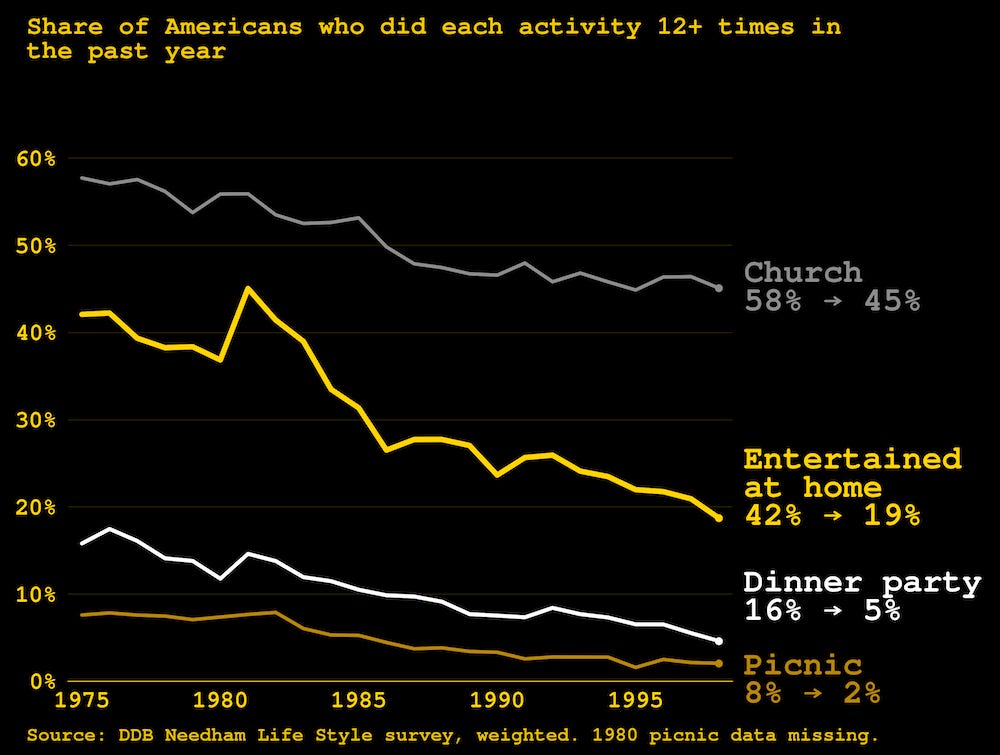
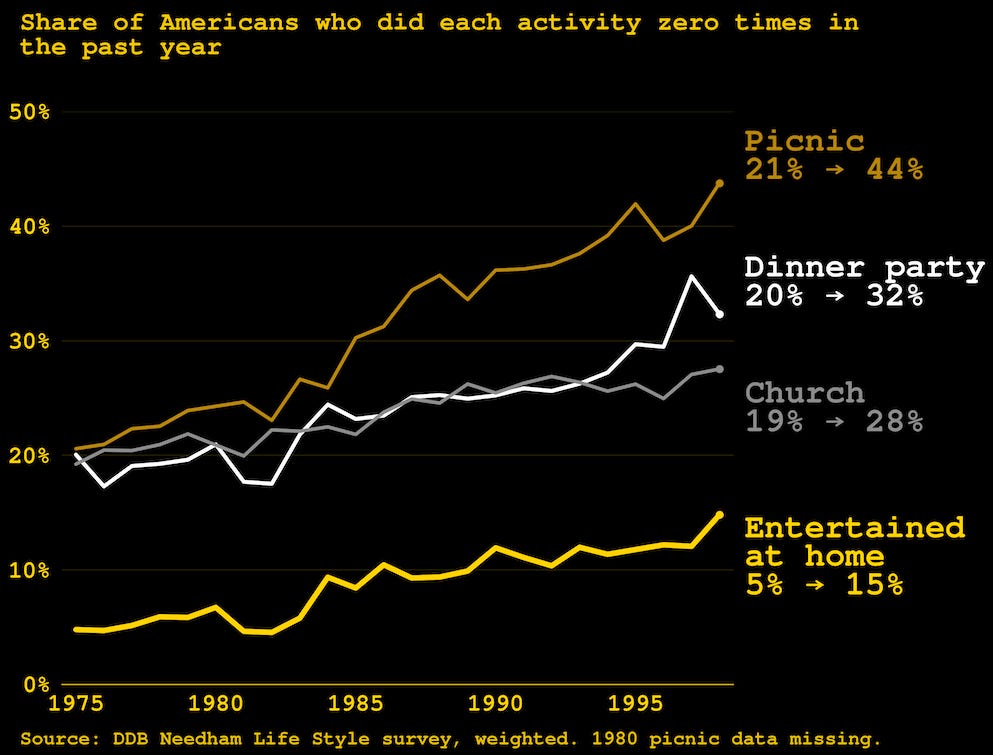
But then something changed. Americans stopped throwing parties. Even more fundamentally, they stopped visiting each other. Between 1975 and 1998, the share of Americans who gave or attended a monthly dinner party declined by half. The share of Americans saying they never entertained people at home tripled. [See charts below] While cultural critics often bemoan the decline of organized religion, the dip in church attendance was downright modest compared to the collapse in hosting, according to data gathered by the DDB Needham Life Style survey.
In his 2000 book Bowling Alone, Robert Putnam wrote that if these trends continued, the ancient practice of visiting with friends “might entirely disappear from American life in less than a generation.” Well, check your calendars. One generation and change later, Putnam’s prediction needs an update.
So, what’s the state of hosting in the 21st century?
Everybody’s Home. No One’s Coming Over.
To get an apples-to-apples answer to that question, the polling group Data For Progress replicated the DDB Needham Life Style surveys cited by Putnam. Fortunately, they were kind enough to exclusively share their findings with me. Unfortunately, the upshot is about as brutal as you’d imagine.
In the last 30 years, Americans have seen double-digit declines in practically every measure of socializing. They are less likely to play cards; attend a sporting event; go to the bar; volunteer; or work on a community project.
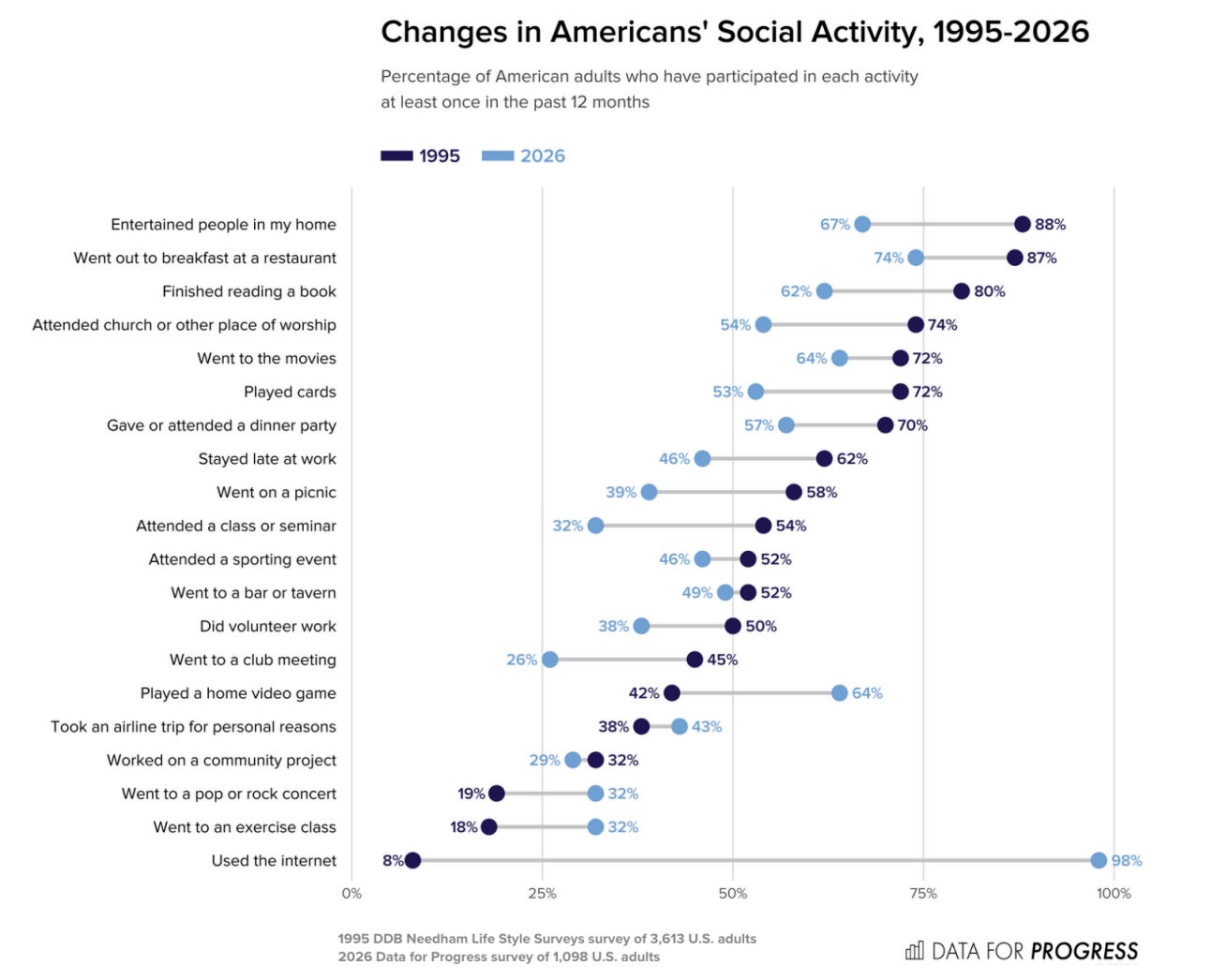
When it comes to hosting people at home, the declines are particularly stark. Since 1995, the share of Americans who say they’ve hosted guests or attended a dinner party has declined by about 20 percent—and that’s in addition to the whopping declines that Putnam bemoaned a quarter-century ago.
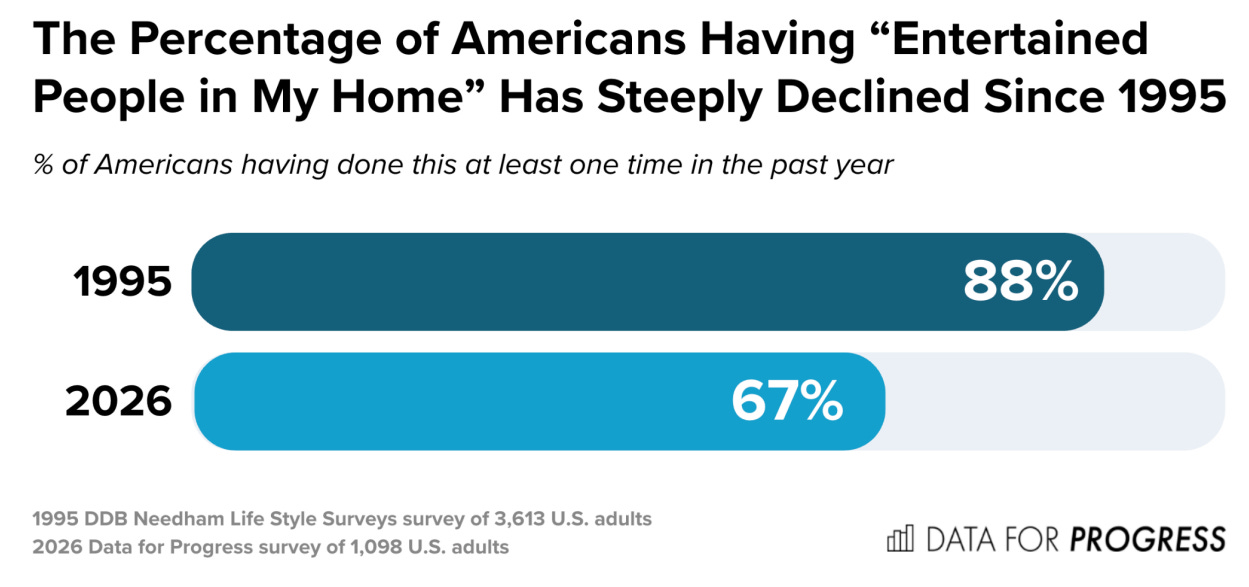
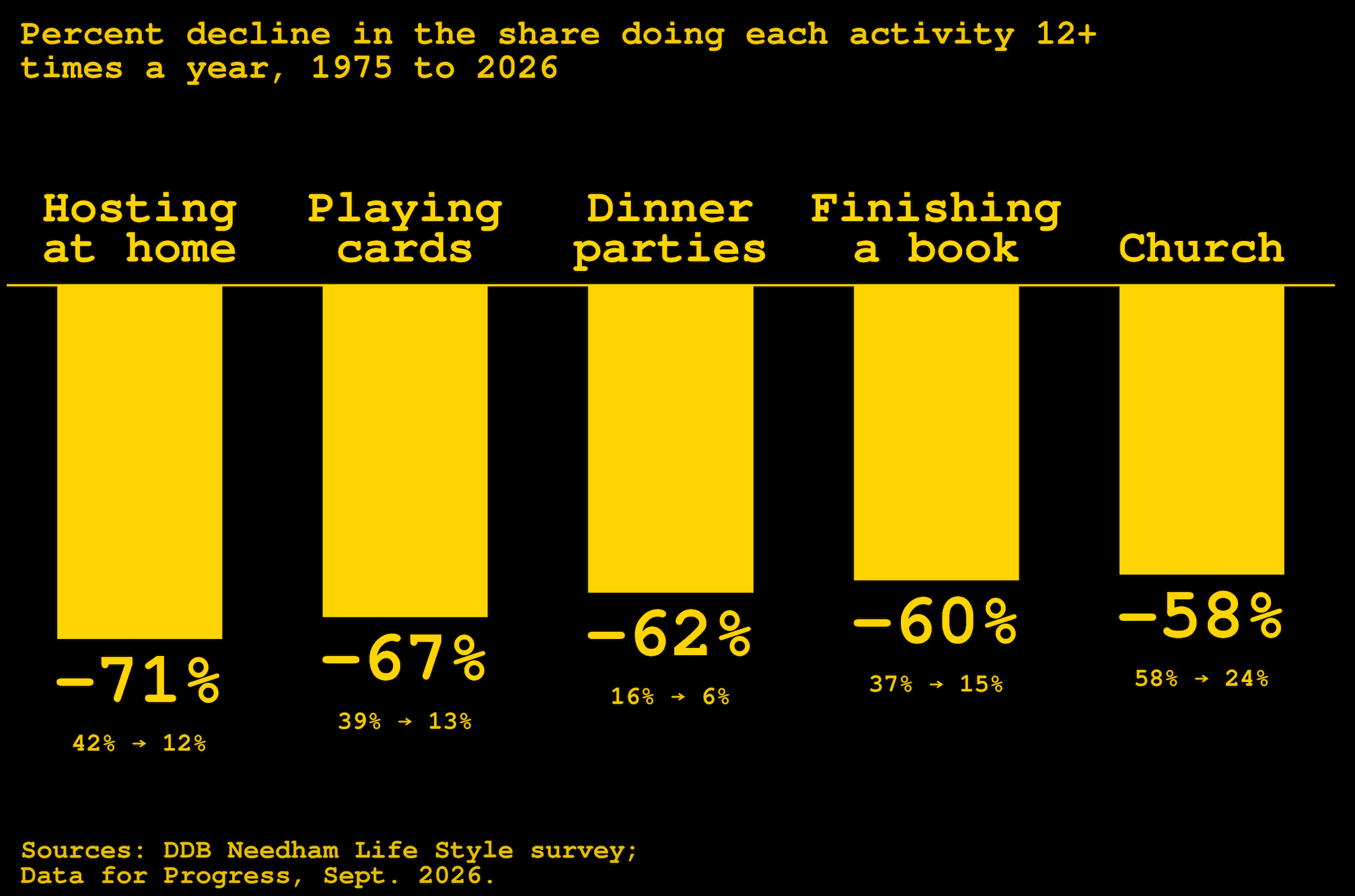
Combining the two surveys, we get this astonishing fact: The share of Americans who say they host friends or family at their home at least monthly has fallen from 42 percent in 1975 to 12 percent in 2026—a 70 percent collapse in a half-century.
So, what’s going on? Let’s first reject a few stories that don’t entirely fit the data.
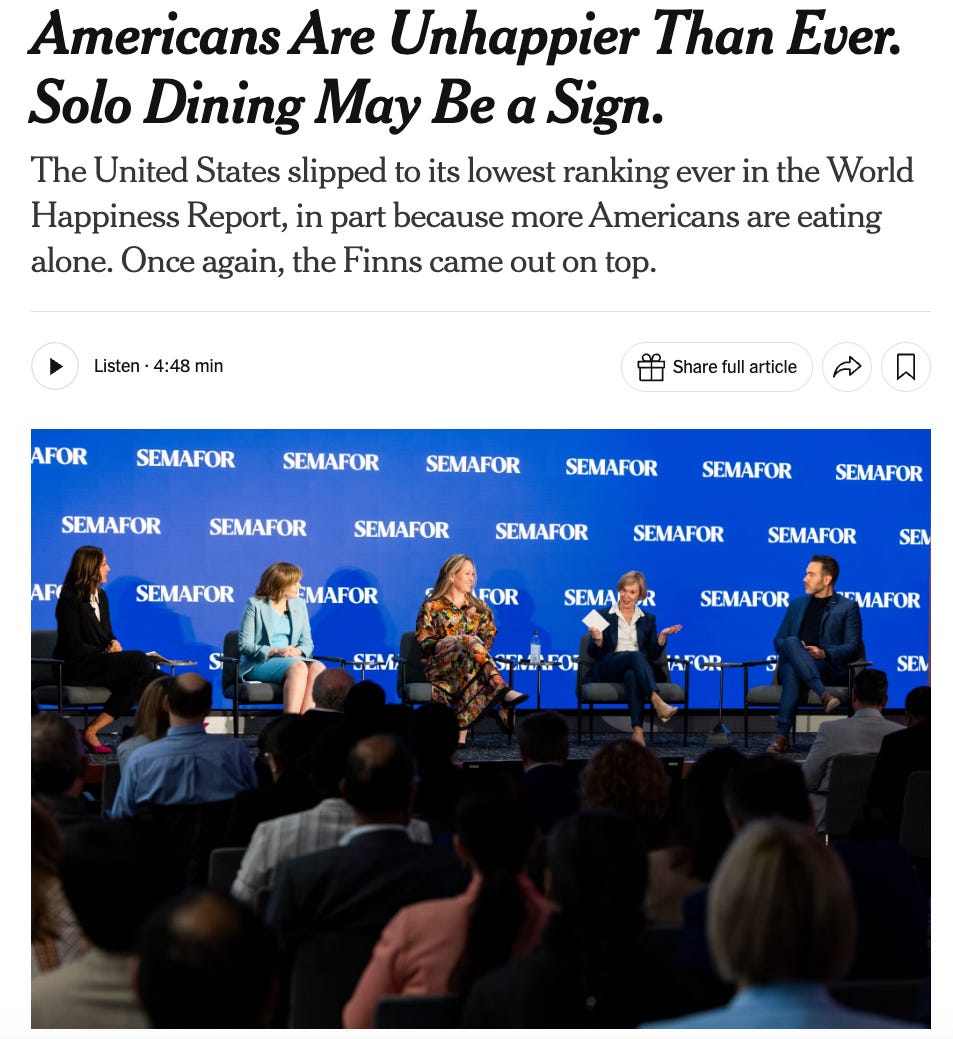
Perhaps, an optimist might think, Americans are hosting fewer dinner parties because they’ve simply moved all their hangouts to restaurants and bars. Nice idea, but almost certainly wrong. As Putnam writes in his book, “the practice of entertaining friends has not simply moved outside the home, but seems to be vanishing entirely.” Overall face-to-face socializing has declined significantly in the last few decades, and the restaurant industry has actually noted a sharp increase in people eating alone. See, for example, this story in the New York Times:
Another plausible theory is that Americans have replaced dinner parties with other forms of healthy socialization. It is absolutely true that there are some activities that Americans do much more often than in 1975, such as going to concerts, traveling, and exercising. All very good.
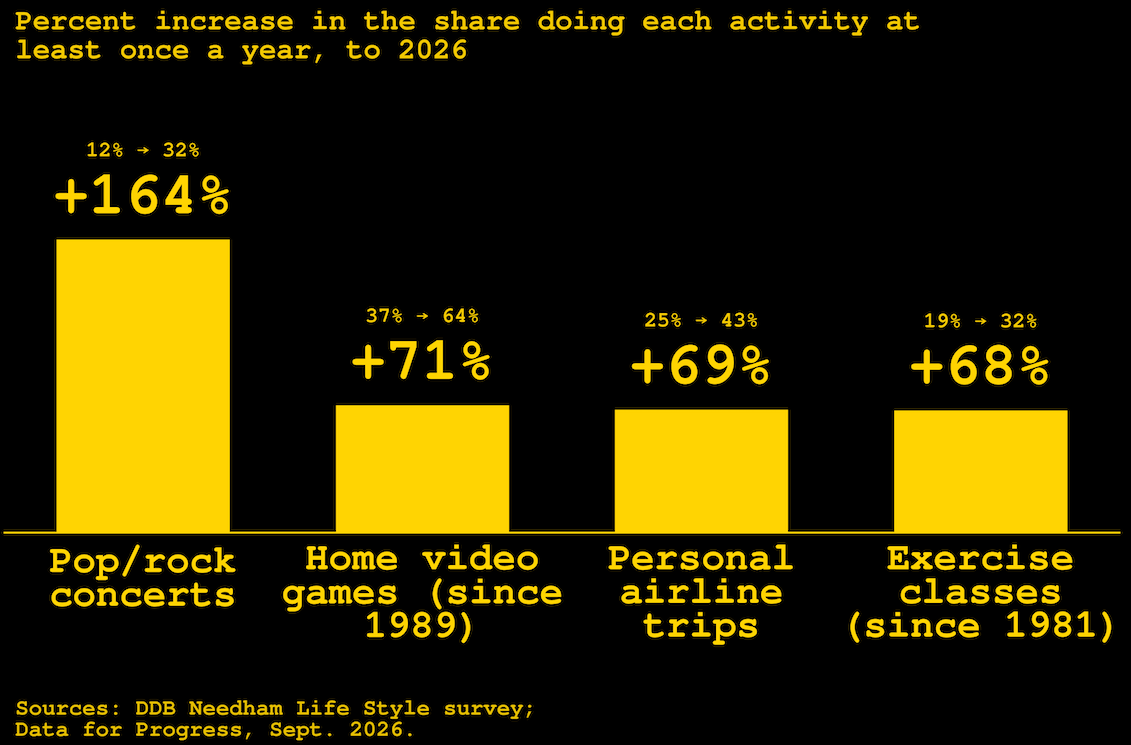
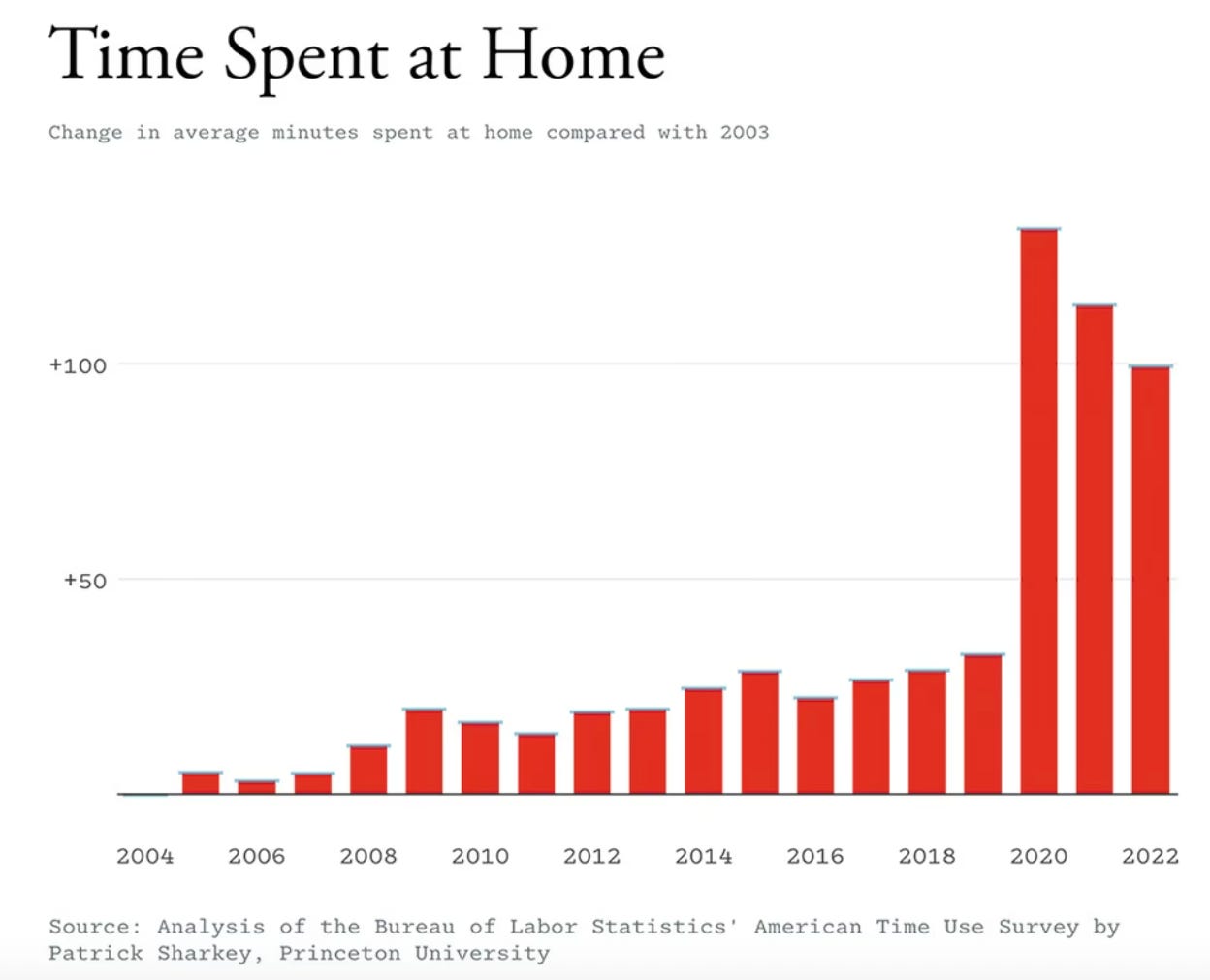
But as I wrote in an essay last year on the “great American exercise boom,” the evidence suggests that, despite the increase in running clubs, the surge in exercise time seems to be mostly solo. A lot of people are going to the gym with a podcast to keep them company (e.g., me) or rolling out a yoga mat in the basement by herself (e.g., my wife). Most importantly, it is impossible to assert that Americans are getting out of the house to socialize in new ways when time spent at home has certifiably exploded since the 2010s.
In short, the great disinvitation is real, and we can’t wish or explain it away by arguing that Americans are just finding new ways to be with friends. Here are fourish explanations:
1. People are more harried, especially dual-earner households
In the 1970 book The Harried Leisure Class, the Swedish economist Staffan Burenstam Linder wrote that as a society gets richer, leisure time takes on the frantic quality of work. As rich people feel like their downtime is scarce—as each non-working hour practically shouts, “excuse me! you could be making money, right now!” —the experience of leisure time speeds up. We multitask and pack various downtime activities into short periods. Firing up a Netflix show at 9pm that you can half-ignore while you answer email is a perfect activity for people who need their leisure time to feel like half-productive box-checking. Taking several hours to coordinate with other busy people to set up a lengthy dinner party is a tougher sell for the harried leisure class1.
That’s a sociological explanation, but I think the decline of hosting is also about macroeconomic trends. In Bowling Alone, Putnam acknowledged that women have historically been the keepers of the family social calendar, planning the birthday parties and neighborhood potlucks. For any number of reasons, women seem to do better than men at making and keeping adult friendships and making plans with other families. But in the 1950s and 1960s, tens of millions of women traded their unpaid household management jobs for salaried jobs, and the family social calendar frayed, as men failed to pick up the slack. As I’ve written:
In 1970, right around the inflection point of America’s social decline, the share of women between 25 and 54 who participated in the labor force surged past 50 percent for the first time; it’s currently near 80 percent. As more women poured their weekdays into 9-to-5 work, men failed to take over the logistical labor required to fill out the social calendar, and adult gatherings gradually eroded in the age of the dual-earner household.
Moving from macro to micro: My wife and I love to host parties at our place in D.C. But these get-togethers are a lot of work: conception, communication, coordination, shopping (are your kids coming, or are you getting a babysitter? does your eldest kid eat eggplant? no? okay, we’ll make pasta. oh, that’s right, your wife’s gluten allergy…). These sort of multi-skilled logistical adventures are almost indistinguishable from the sort of logistical problem-solving that characterizes a good deal of white-collar work. But when both parents are already inundated with literal white-collar work, it’s hard to add the job of unpaid party planner.
The trouble with going all in on this explanation—beyond the fact that it embraces a version of learned helplessness for men—is that leisure time has increased overall since the 1950s. Theoretically, married couples should have even more time to have people over for food and drink. Other facts must be squeezing out socializing …
2. Intensive parenting leaves less time for hosting
Americans used to have many kids whom they cared for sparsely; now they have fewer children to whom they devote every minute of their lives.
The numbers here are unreal. The sociologists Liana C. Sayer, Suzanne M. Bianchi, and John P. Robinson wrote in 2004 that between 1975 and 1998, mothers increased the amount of time they spent with their kids by about 200 minutes a week. In the 21st century, mothering time has continued to rise. For married fathers, parenting time increased by even more.
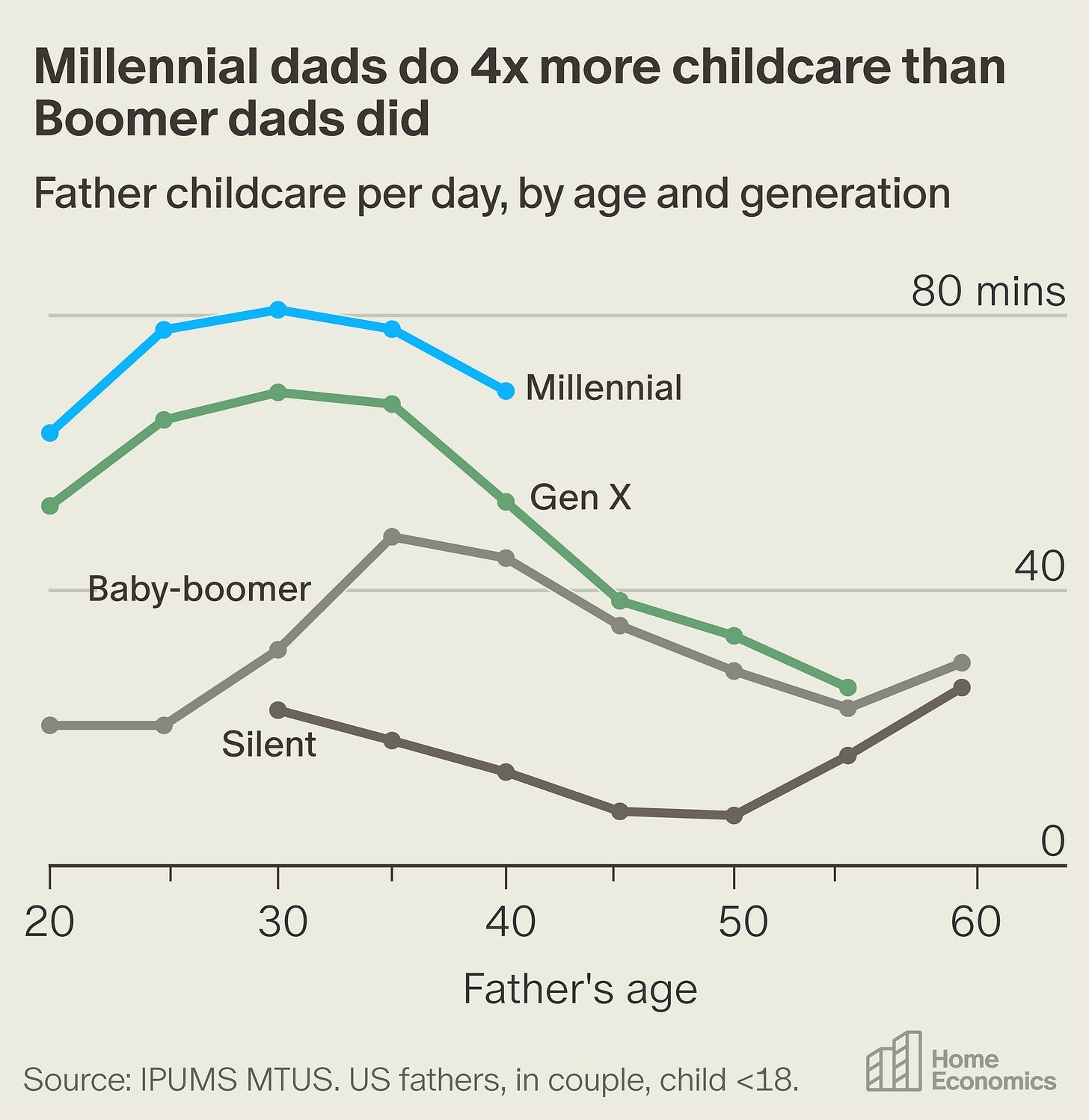
Thus evenings once spent hosting adults are now spent holding, bathing, driving, tutoring, playing with, and talking to their children.
3. Friendship networks are shrinking, especially for poor people who aren’t married
If you’re going to throw a dinner party, there are a few things you probably need first. Say, a dinner table. Chairs. Food and drink. And also: friends. It is rare to host a dinner party for people you’ve never met. But the average number of close friendships is declining with each generation, and the decline is steepest for Americans without a college degree. So, it’s not just that married people have fewer dinner parties; poor people, who are less likely to be married, have fewer friends, period.
According to Data For Progress, the two groups most likely to say they never entertained people in their home in the previous year were political independents (44 percent) and people without a college diploma (39 percent). The latter isn’t surprising, given all the evidence that socializing is declining most rapidly among poorer Americans with less education. Hosting friends, like so much socializing, is in danger of becoming a luxury good.
The political wrinkle is more intriguing to me. I sometimes hear from people who tie everything back to politics that political polarization might lead to social fragmentation. But I wonder if the opposite is just as plausible. Maybe people who are less embedded in strong social networks are less likely to attach themselves to groups of all kinds, including political parties. In this way, America’s long-term detachment from groups and institutions is leading to a kind of pox-on-all-parties mentality that cashes out in an increase in independents.
4. It’s too much fun to be home alone.
There is a story you could tell about the rise of aloneness being the product of mostly positive trends. In the 20th century, perhaps, many housewives planned dinner parties out of a feeling of crushing isolation. Children were forced to attend church ceremonies that invalidated their identities and values. Americans felt suffocating social pressure to attend social events with neighbors and congregants that they hated. Now we are free to be exactly who and where we want to be.
For many, this freedom has taken the shape of a living-room couch. The average time that Americans spent at home increased by almost two hours a day from 2003 to 2022. Cocooned within personalized entertainment fortresses, more Americans have shrunk the vast buffet of all possible leisure activities to the small plate of screened media. As I wrote in my 2025 essay “Everything Is Television,” it sometimes feels as if the grand sweep of entertainment history is drawn toward the single attractor point of video, and especially short-form video. Something quite deep in the human psyche seems to want desperately to turn off our self-talk and silence our nattering internal monologues by turning up the volume of other characters’ voices.
Final Thoughts (or: The Lump of Leisure)
In sum: The death of the host is the story of lonely unmarried people and harried married dual-earner households; anxious parents spending more time with their children and less time with friends; and the typical home becoming such a riot of diverting comfort that people no longer have to invite human beings to interrupt their boredom.
For 200 years, people have worried that machines would make human labor unnecessary. This false assumption is commonly known as the Lump of Labor fallacy. (The finite lumpiness of the labor market is the fallacy here, because people keep finding new lumpy problems to turn into jobs.) But machines in the last half century have accomplished something stranger. They have made other people less necessary to our leisure. Every generation has acquired better ways to entertain itself without leaving the house. The result is a peculiar triumph of modern abundance: We have built a world in which being alone has never been easier, more comfortable, or more fun. And then we wonder why everybody stopped coming over.
Leisure, as an activity to be enjoyed with other people, turns out to be more finite than work. The lump of labor fallacy was wrong, as technology keeps failing to replace jobs. But something else (the Lump of Leisure Theory?) might be right on the money. Social leisure turns out to be the real lump—something finite and easily displaced by technology. Our technology keeps getting better. Our social lives keep getting smaller.
Is this what we want? At the risk of invoking Clintonian levels of abstruseness, it depends on what “want” means. Everybody might prefer, in the abstract, a world of dinner parties, neighborhood friendships, and spontaneous gatherings. But on any given Wednesday at 7:45pm., it is easier to look at a screen than to host a party; easier to listen to a podcast while doing yoga than to plan a gathering. This is not so much an individual failure as a coordination failure. Modernity has shifted leisure from activities that require coordination with other people toward activities that can be consumed without the permission or participation of others. Compared to TikTok, a dinner party is a terrible leisure technology. It requires matching schedules, cleaning the house, buying food, accommodating children and allergies, tolerating awkwardness, and taking the risk that the evening is mediocre. By contrast, what does television ask of us? Nothing. TikTok? Even less. We keep creating opportunities for downtime that eliminate the need for other people to be present. Not all progress is progress.
I think there might also be something mathematical at play here, which I could explain better if I were better at math. If I get 20% busier and my friend gets 20% busier, the difficulty of planning a hangout doesn’t increase by 20% but rather increases by some product of his increase multiplied by mine. Scaled across society, this would imply that mild increases in individual feelings of being harried might result in severe decreases in nationwide socialization. Does this make sense? Only kind of? Do you see now why I relegated the observation to a footnote?
30 years ago while we were living in London, we had a group of friends that we would get together with almost every weekend. We'd alternate flats were we'd meet, make a bunch of food, and just hang out. As the years have passed, and we've moved numerous times to multiple places, the hosting and get togethers have diminished. But, even up until about 10 years ago we would at least have a yearly Christmas party and routinely have people over to grill during the summer. But, I noticed a shift even right before Covid. People seemed almost put out by being asked to come over for a get together or party. The fact that people (not the ones hosting mind you) felt as if it took too much effort to even show up was a thing.
Then, Covid pretty much killed socializing at people's homes. I do think the decline has to do with our ability to more easily entertain ourselves without interacting with other people. But, there is also a sense that it's not as important to make the effort - whether that be dressing up or simply making an appearance at a gathering. It is easier to be self-obsessed and consumed. How do we convince people that it might be worth changing our behavior not only for our own wellbeing but the greater good?
Great article Derek. One idea you could probably add to the "People are more harried..." topic is the problem of high expectations. I have challenges convincing my spouse to have people over because she is always embarrassed that our house isn't as clean as it should be or we are in the middle of a renovation project leaving a mess in one room. Our house is great, but doesn't meet a level of high expectations. I'm doubtful people in the 1950s had these same concerns.