
How American Dads Became the Parents Their Fathers Never Were
Compared to their parents, Millennial fathers have roughly tripled the amount of time they spend with kids. The new American dad is more present and more exhausted—but also, more satisfied with life.


Today’s article was written with Aziz Sunderji, an economic analyst and data whiz who writes at Home Economics.
American fatherhood has transformed in the last few generations. Compared to their Boomer parents, childcare time among Millennial dads has more than doubled. Compared to their Silent Generation grandparents, it’s nearly quadrupled. You will be hard-pressed to find any part of day-to-day modern life that has changed more in the last half-century than the way today’s parents—and fathers, in particular—spend their time.
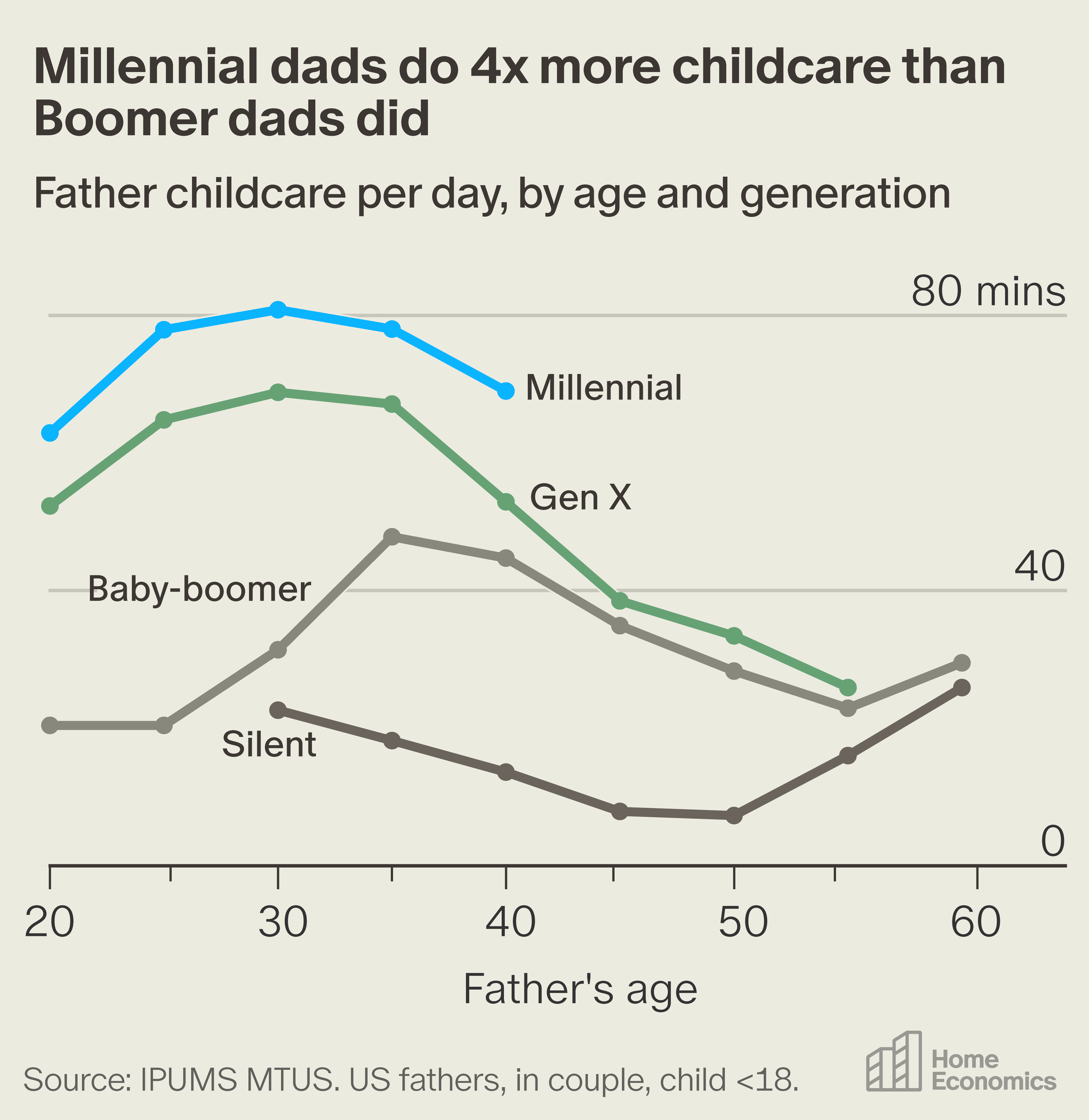
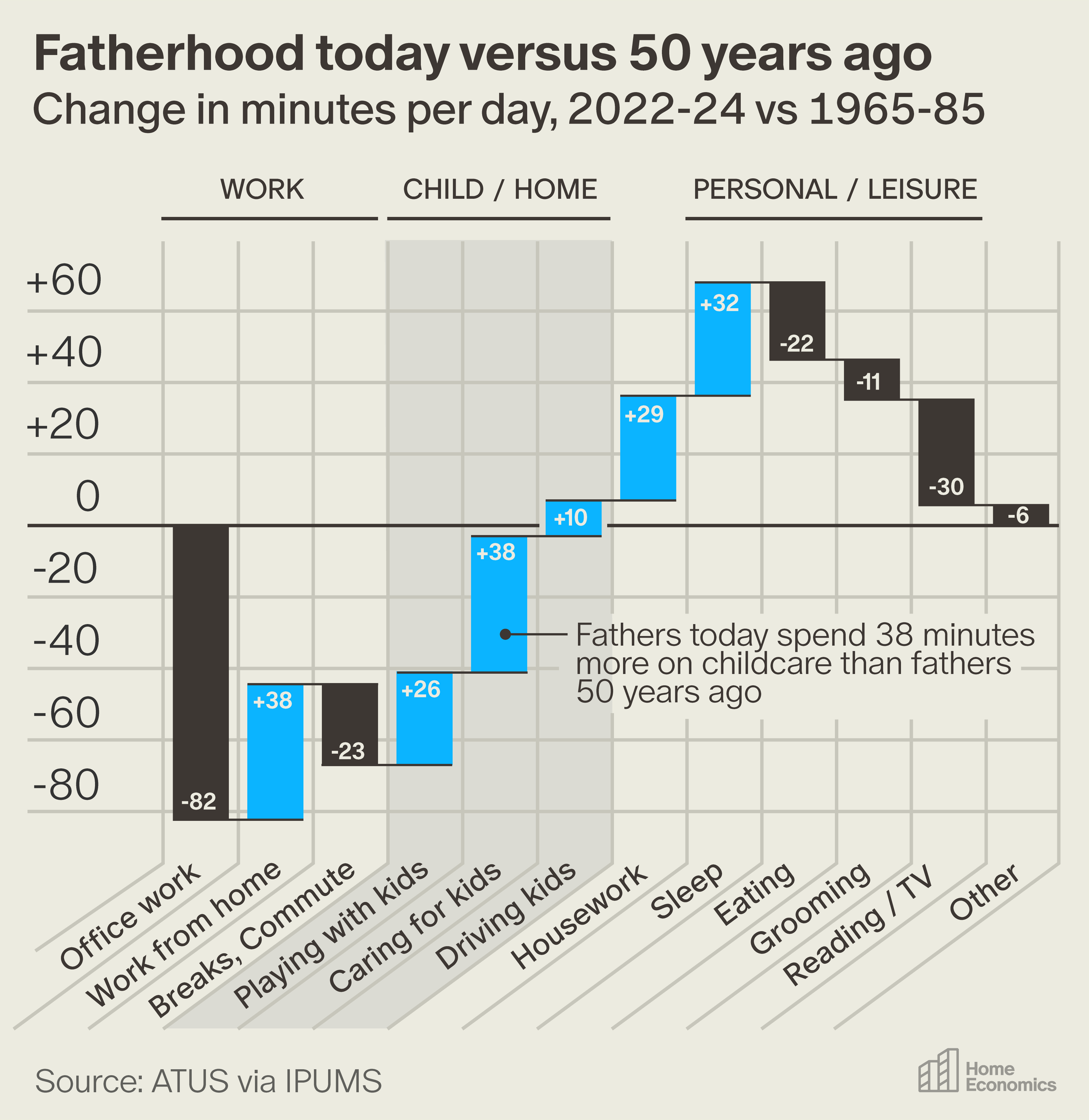
In 1965, the typical married father barely spent half an hour each day actively engaged in childcare, according to the best time-use data we have1. Today, Millennial thirty-something dads typically spend more than 80 daily minutes changing diapers, reading and playing with their children, driving them to soccer practice, and going over homework. To make time for kids, modern fathers have reduced their daily office work by more than an hour—not to mention, cut down their TV time by 30 minutes—as they pour more of their waking life into being at home.
For those familiar with the parenting norms of the 20th century, the rise in childcare might seem like a violation of tradition, as if we are moving away from the natural state of fatherhood. But as the psychologist Darby Saxbe writes in her forthcoming book Dad Brain, the role of fathers has always varied significantly around the world, much more than the role of mothers. In African tribes that require men to do lots of hunting, dads often play a small role in the lives of their kids. But barely a few hours’ drive away from these tribes, one can find hunter-gatherer societies, like the Aka community in the Congo, where fathers are constantly around their children.
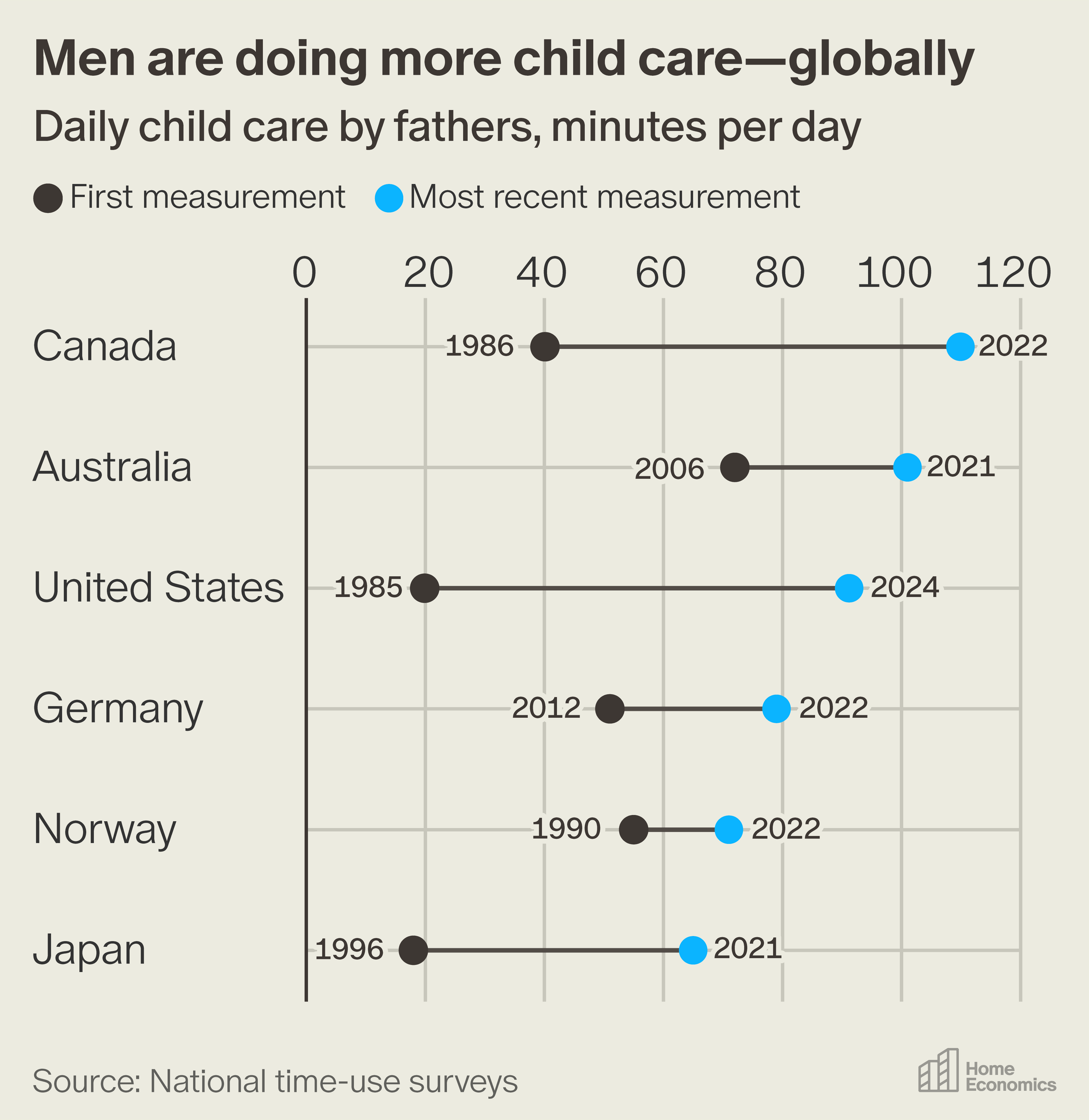
The working-husband-and-housewife norm is not a biological inscription in our genes. It is an invention of the Industrial Revolution. And it is disappearing around the world. In addition to the U.S., fathers’ childcare time is surging in Canada, across Europe, and in other rich countries, such as Japan.
WHERE DID MODERN FATHERHOOD COME FROM?
The simplest explanation for the global surge in fathering is that it’s largely about the mass entry of women into the workforce.
Since the 1960s, the female labor force participation rate has risen, which meant fewer moms stayed at home to take care of the kids. As households moved toward dual earners, someone had to cover the remaining childcare— and that someone, in most households, turned out to be the dad.
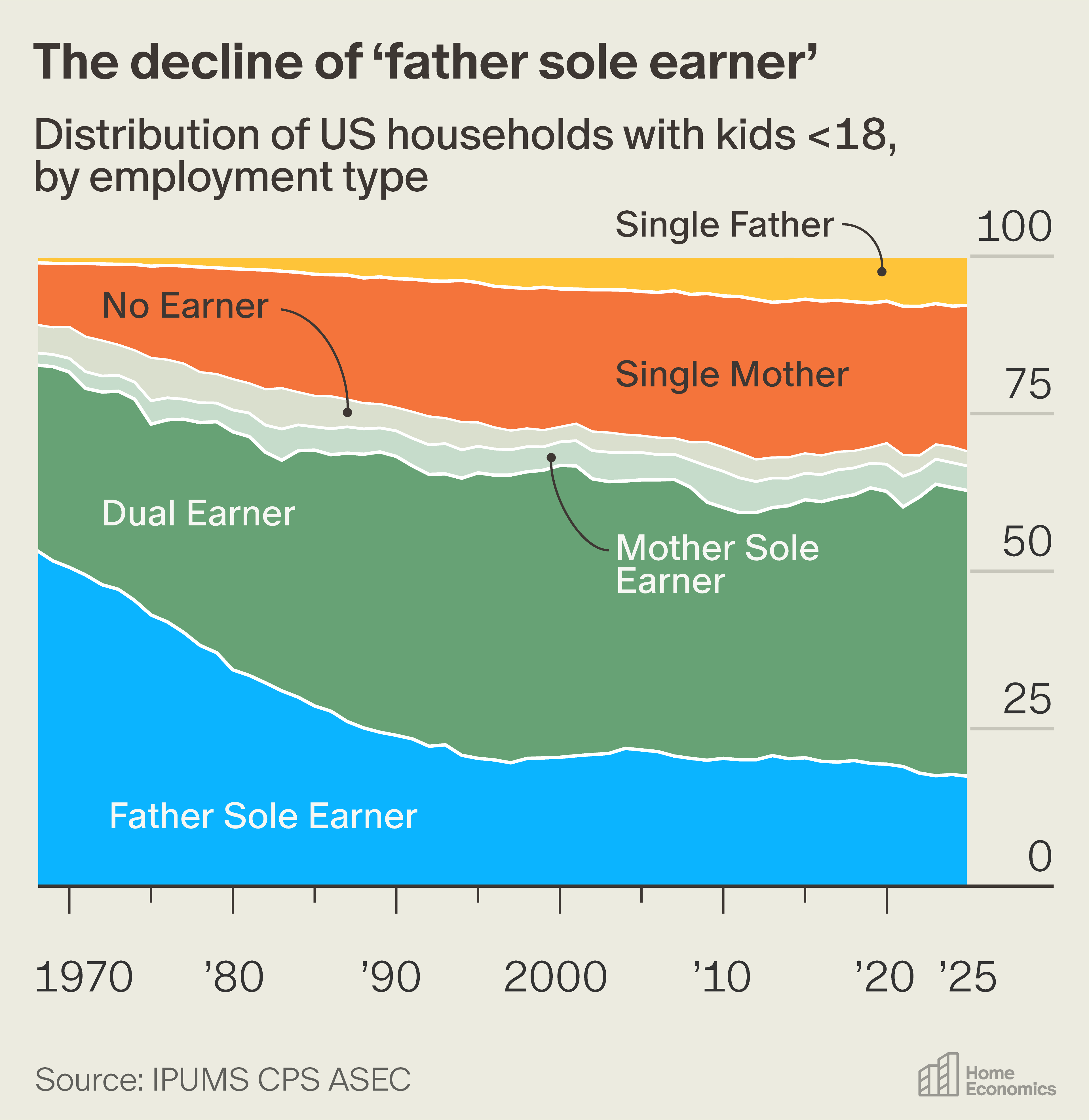
As pat as this theory seems, it has some interesting flaws. If caring for children required a fixed set of hours, then we’d expect to see dads taking parenting-time hours from moms. Except, mothers’ childcare time hasn’t gone down in the last half century. It’s gone way, way up, as well. What’s more, if the decline of the “male breadwinner” household were the primary reason for the increase in fathers’ childcare time, we would expect to see these two trends happen simultaneously in the 20th century. But they didn’t. The “male solo earner” household—that is, families where the dad works and the mom stays at home—declined fastest as a phenomenon between the 1950s and the mid-1980s. Meanwhile, the steepest sustained increase in male childcare happened decades later, between the 1990s and early 2000s, during a period when household structures were relatively stable.
Even if the rise of working mothers didn’t automatically and instantly transform fatherhood, it may have set in motion a slower-moving shift in norms. In the second half of the 20th century, men who expressed more egalitarian gender attitudes were among the first to shift their time toward direct childcare, as the sociologist Scott Coltrane wrote. As a result, the definition of a “good dad” morphed—or, perhaps we should say, expanded—from the strict and narrow norm of “just a breadwinner” to the broader, multi-part role of “earner and co-parent and diaper-changer and chaperone and baseball coach and, and and …” With the rise of women’s participation, the job of being a mom became more complex, and the role of being a dad got more complex, too.
But we think the rise of modern fatherhood is about more than the rise working moms. So, let’s consider three additional explanations.
Maybe childcare time went up because dads … enjoy parenthood?
This can’t be it, your cynical side is telling you. So cheesy. Too simplistic.
But let’s consider. In a 2008 paper, “Parental Education and Parental Time with Children,” Jonathan Guryan, Erik Hurst, and Melissa Kearney found that, in the U.S. and across the developed world, it has been the most educated parents who have most increased their time spent with children. Our own analysis shows that the increase in fathering time is significantly driven by changes among college-educated fathers under 45 years old. In the 1960s, fathers with a bachelor’s degree only spent about 9 additional minutes taking care of their kids, compared to dads without a high school degree. In the last 60 years, that education gap has quintupled to 46 minutes.
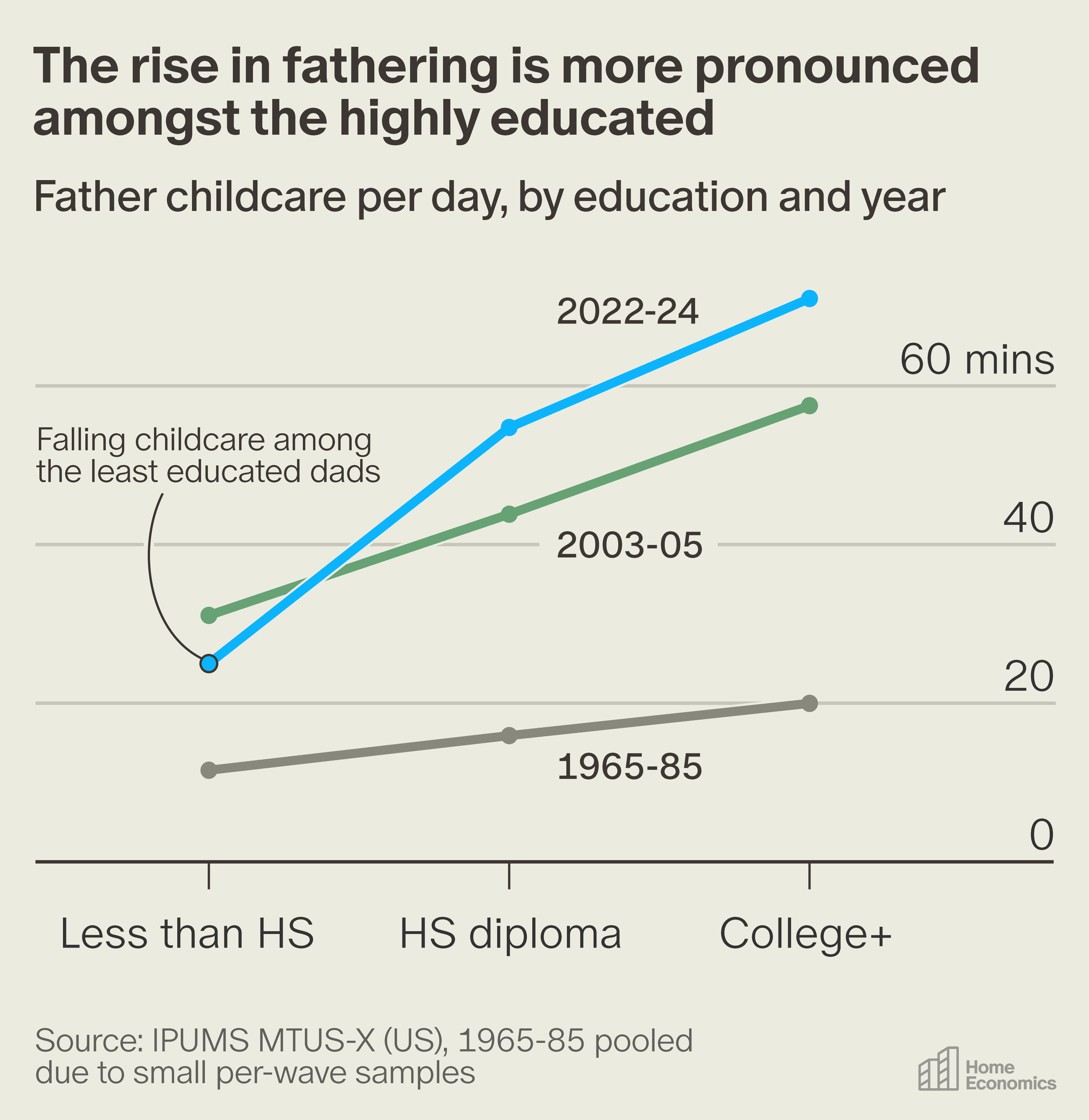
The most educated parents are typically the richest. They could do anything with their time. If one thinks of childcare as just another form of housework, like vacuuming or dusting shelves, it seems awfully strange for the most educated and wealthy to fill their lives with the drudgery of diapers if they don’t have to. The rise of dad time makes more sense if parents regard childcare as a form of leisure.
In fact, Guryan et al. found that “parents report that spending time with their children, especially in recreation or educational child care, is among their more enjoyable activities, especially when compared with other standard home production activities.” Our analysis of government data concurs. According to the American Time Use Survey well-being questionnaire, fathers say that little brings them more joy than being with their kids, other than hanging out with friends.
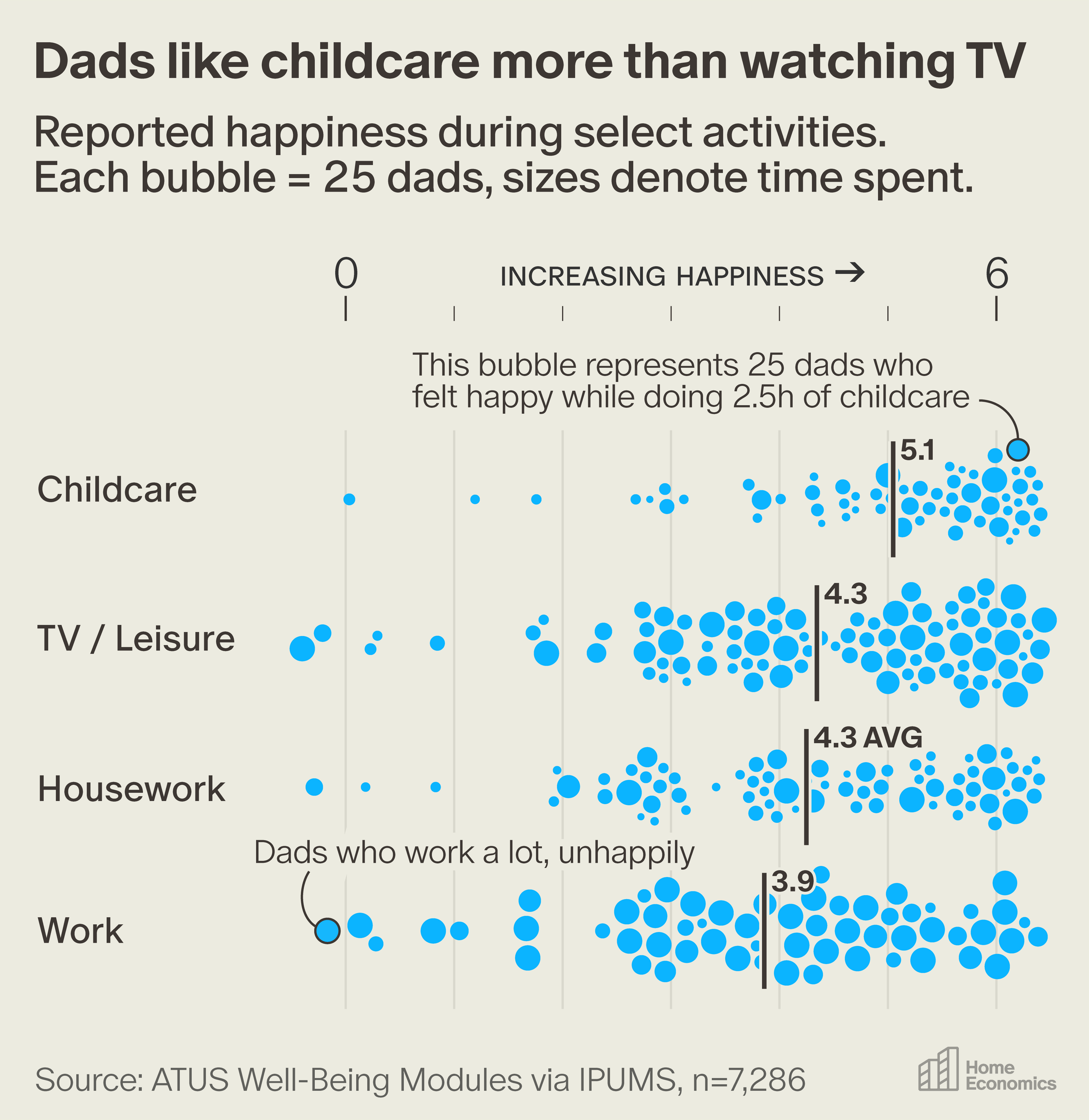
The fact that richer and better-educated parents are freely choosing to pour more of their valuable time into childcare makes raising children sound practically like a “luxury good,” akin to buying a Rolex watch or a fragile Fabergé egg.
Parents reading along might wonder if we’re overrating the unalloyed bliss that is fatherhood. Perhaps, a skeptic might think, it’s not mere love and joy that’s motivating all this extra time spent with kids. Rather, it’s anxiety—and status anxiety in particular.
The rise of intensive parenting isn’t just about love. It’s also about fear.
In their 2010 paper “The Rug Rat Race,” the economists Garey and Valerie Ramey tried to understand why childcare time soared among college-educated parents in the 1990s. One of their more controversial findings was that surging childcare was a rational response among anxious parents who were desperate for their kids to get into the best colleges.
The Millennial generation was the largest in American history. But the number of seats in prestigious undergraduate schools did not keep up with the population boom. The mad scramble for scarce college seats—and, by extension, for scarce entry-level jobs at prestigious companies and organizations—inspired an extracurricular arms race among college-educated parents, which cashed out in much more parenting time. In this interpretation, the increase in childcare isn’t just about love. It’s about fear—fear of our children disappointing us, and fear of us disappointing ourselves (not to mention our friends, family, neighbors, and online group chats)2.
As highly educated parents in the late 20th century and early 21st century have come to regard their children as adorable assets worthy of our precious investment, childcare has become a visible status signal. Dads who enthusiastically coach one kid’s basketball team and drive another child to ballet on the weekends aren’t just investing time and resources to enhance their kids’ likelihood of getting into the best schools and entry-level jobs when they grow up. These fathers are also demonstrating to other parents just how impressively involved they are in their children’s lives. As high-income parents compete to show who can be The Most Parenting Parent, it can create a logistical arms race of scheduling, transporting, and coordinating … until we all look up and see that this yuppie status competition has created more work for everybody.
In short, with the rise of this new “intensive” style of parenting, we replaced the old-fashioned breadwinner ideal with the lofty co-parent ideal, and then we raised the difficulty setting for everyone by turning childhood into an intensive investment project.
Modern fatherhood might have something to do with the decline of socialization, too.
Since the 1950s, Americans have spent less time socializing and more time alone. As the researcher Marc Dunkelman has pointed out, many families during this period have increased their closeness. Partners can text each other hundreds of times throughout the day and track their kids’ credit card spending on their phones. While many close ties are tighter than ever, weaker ties to community and the outside world have melted away. Phone time has topped off television time, and more of our lives have gone indoors. As adult leisure shifted from public life to home life, men are now physically present in the home more often, and childcare rose partly as a byproduct.
Saxbe, the psychologist, writes about how traditional hunter-gatherer societies defray the burden and joy of childcare across “alloparents”—that is, extended family, siblings, and community members who help raise kids. In America’s more atomistic and isolated society, we put more pressure on the nuclear family now that those networks have shrunk. That means dads are taking on some of the extra care burden that a grandparent, aunt, and older sibling might have shouldered in previous generations.
There’s probably a bit of truth to all of these explanations. Fathers’ childcare time increased fastest in the generation after women stormed into the workforce, as the dual-earner household model required that parents spread the labor of raising kids. Childcare time continued to increase when many fathers realized that it brought them deep satisfaction. At the same time, the surge in intensive parenting among educated moms and dads was also a stress response, with many parents fearing that anything but the most over-scheduled childhood would mark them with a scarlet letter—A for “apathetic parents.” And all of this is happening in a period when socialization is in decline, which means parents’ lives are more likely to revolve around their children than in the 1950s and 1960s, when parents were (sometimes infamously) more interested in their own lives than in the careful pruning of their children’s extracurricular calendar.
DON’T FORGET ABOUT MOM
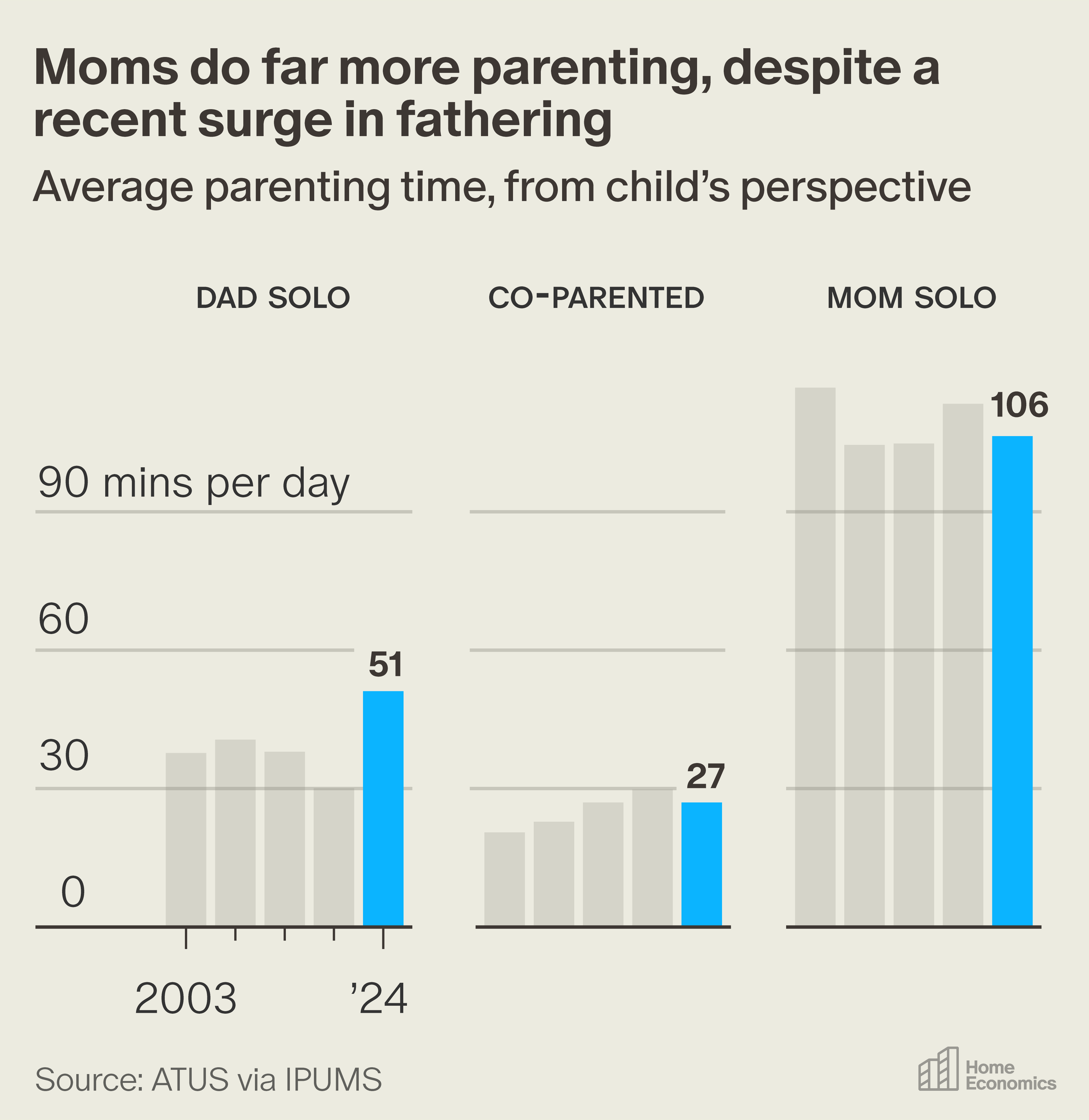
Despite the large increase in dads’ childcare time, there is no question that mothers still spend much more time raising children. This is especially true when we look at solo parenting. According to the American Time Use Survey, mothers’ solo childcare time is still twice that of fathers.
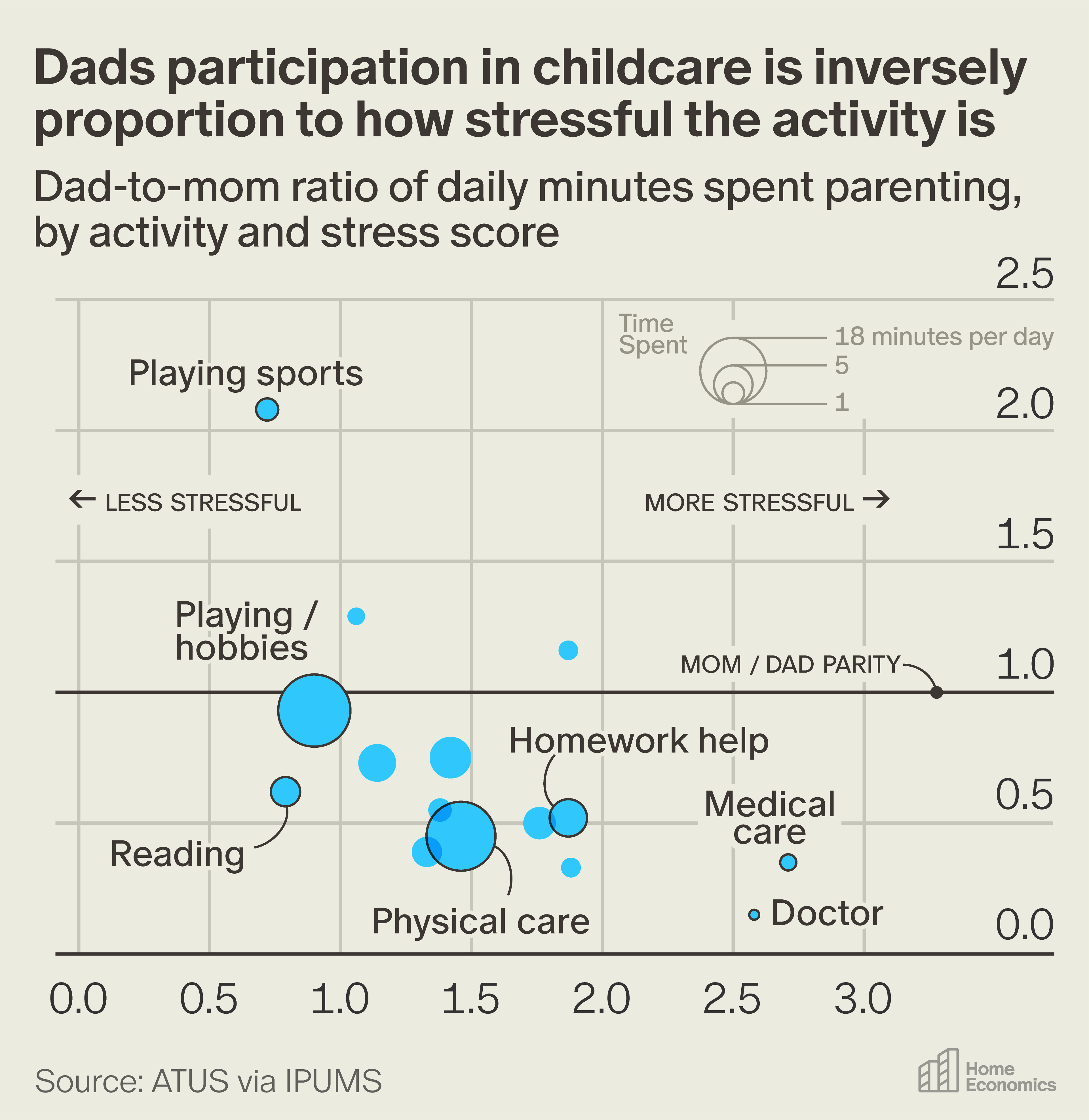
It’s not just that moms spend more time with kids. They also pick up the most stressful responsibilities. While fathers spend more time playing sports with their children, mothers spend more than twice as much time providing medical care, planning appointments, and taking care of the so-called mental load of parenting (i.e., not just driving your kid to the birthday party, but also remembering that classmate’s birthday party existed in the first place and buying a present ahead of time). In fact, the more stressful the childcare activity is, the more likely mothers are to do it.
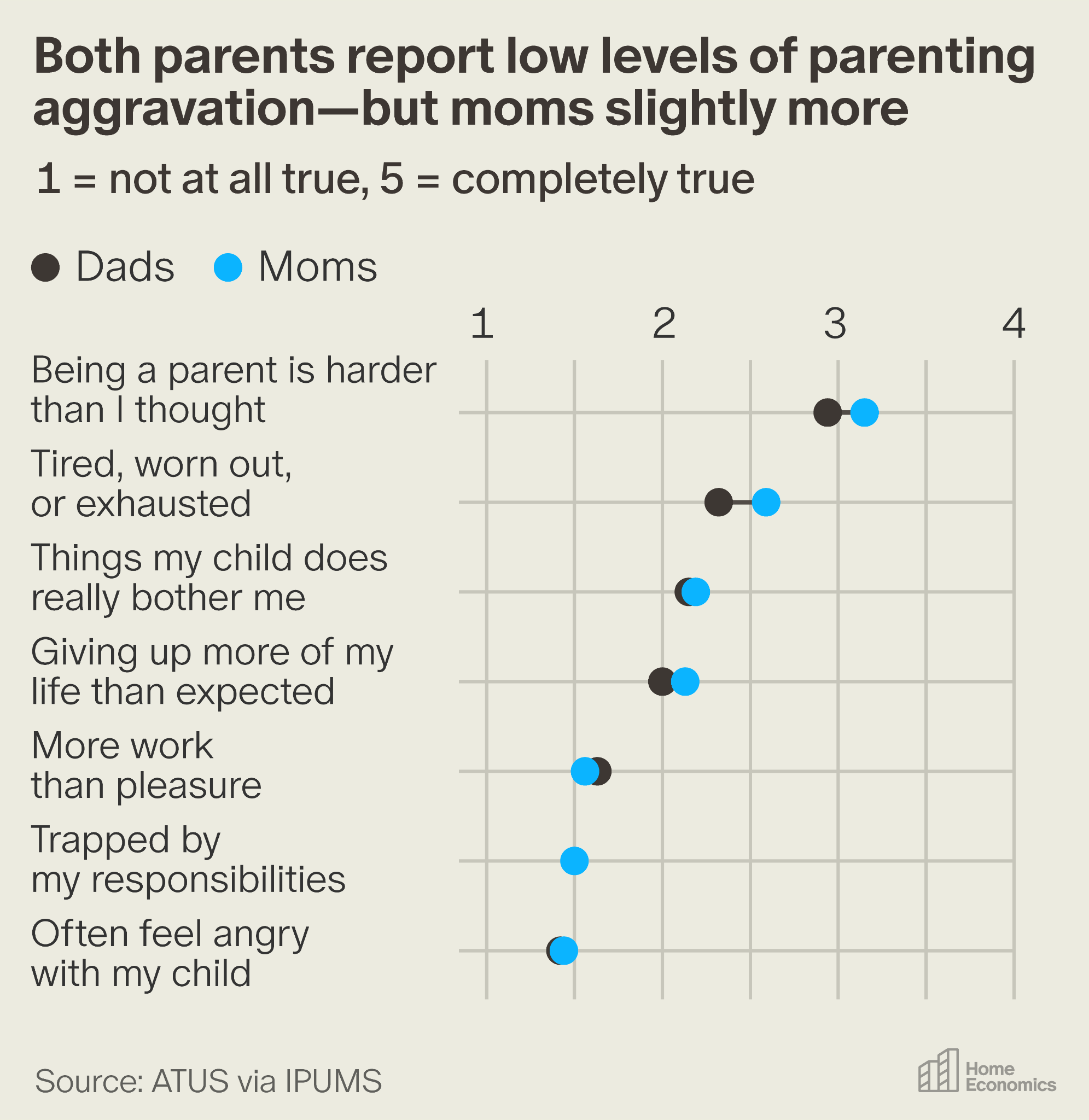
Perhaps relatedly, moms feel more stressed about parenting than dads do. Moms are more likely to say that parenting is harder than they anticipated; more likely to say they “often feel tired”; and more likely to say they feel frequently nervous about being a parent.
HOW FATHERHOOD CHANGES MEN’S LIVES
When a person becomes a dad, what does he lose? What does he gain?
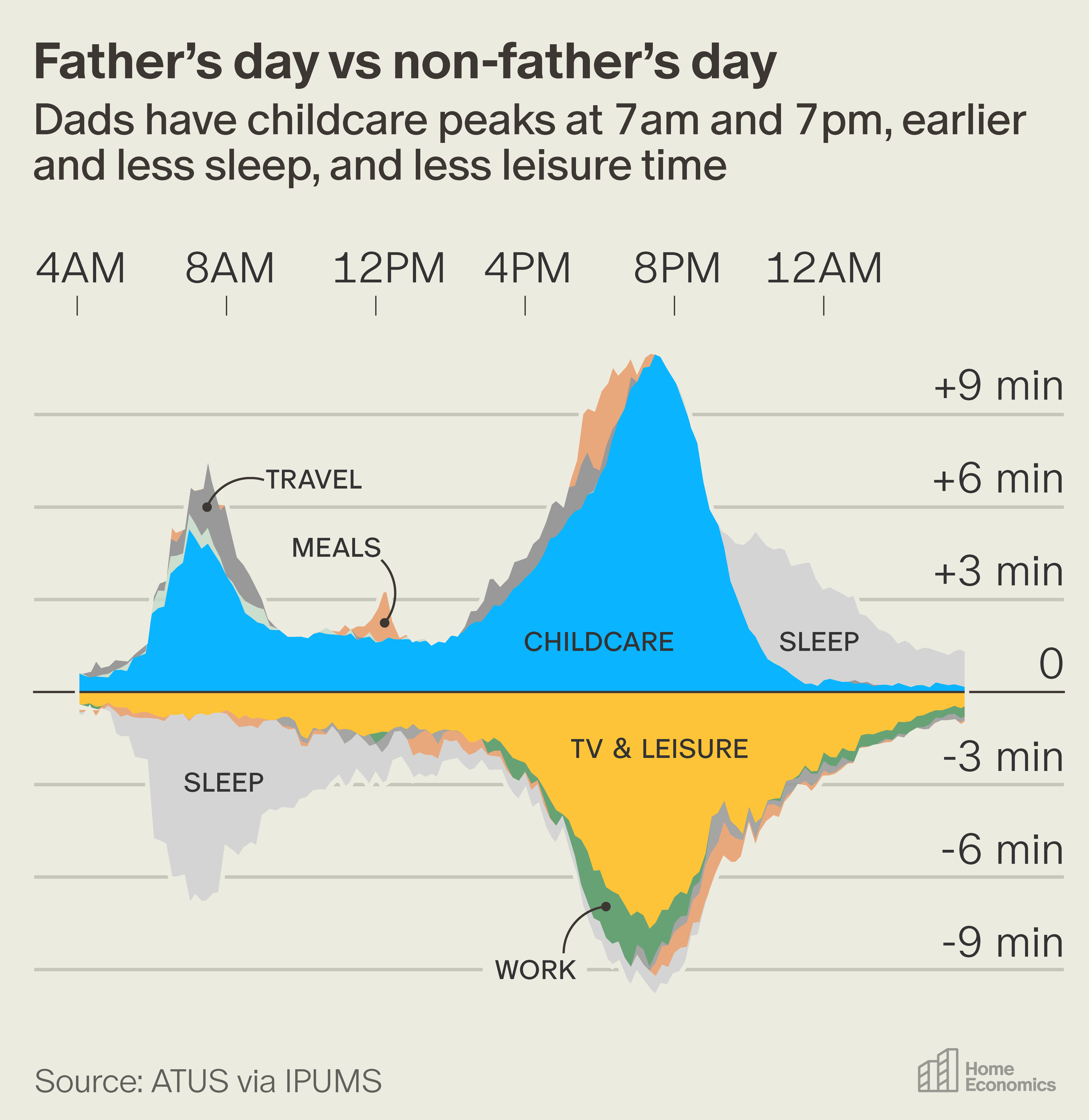
American guys watch a lot of television. When you become a dad, it’s very hard to keep up with all the movies, TV shows, and sports that you followed before you had kids. The rise of childcare time most directly seems to replace TV and similar forms of leisure. What’s more, becoming a dad seems to turn many late-night owls into early birds, as dads spend much more time sleeping between 9 p.m. and 3 a.m. to account for lost sleep in the early morning.
Does becoming a dad make people health and happy? It’s complicated. Saxbe, the psychologist, points out that new parents often have short-term loss of brain volume, but older parents tend to have larger and healthier brains than their childless retired friends. This might have something to do with the fact that caring for young children can be exhausting at first, but over time parenting is intensely social, and socialization tends to be neuroprotective in the long run. It is scientifically valid, therefore, to argue that becoming a father is both a brain-shrinking and brain-expanding life choice. Parenthood is anything but simple.
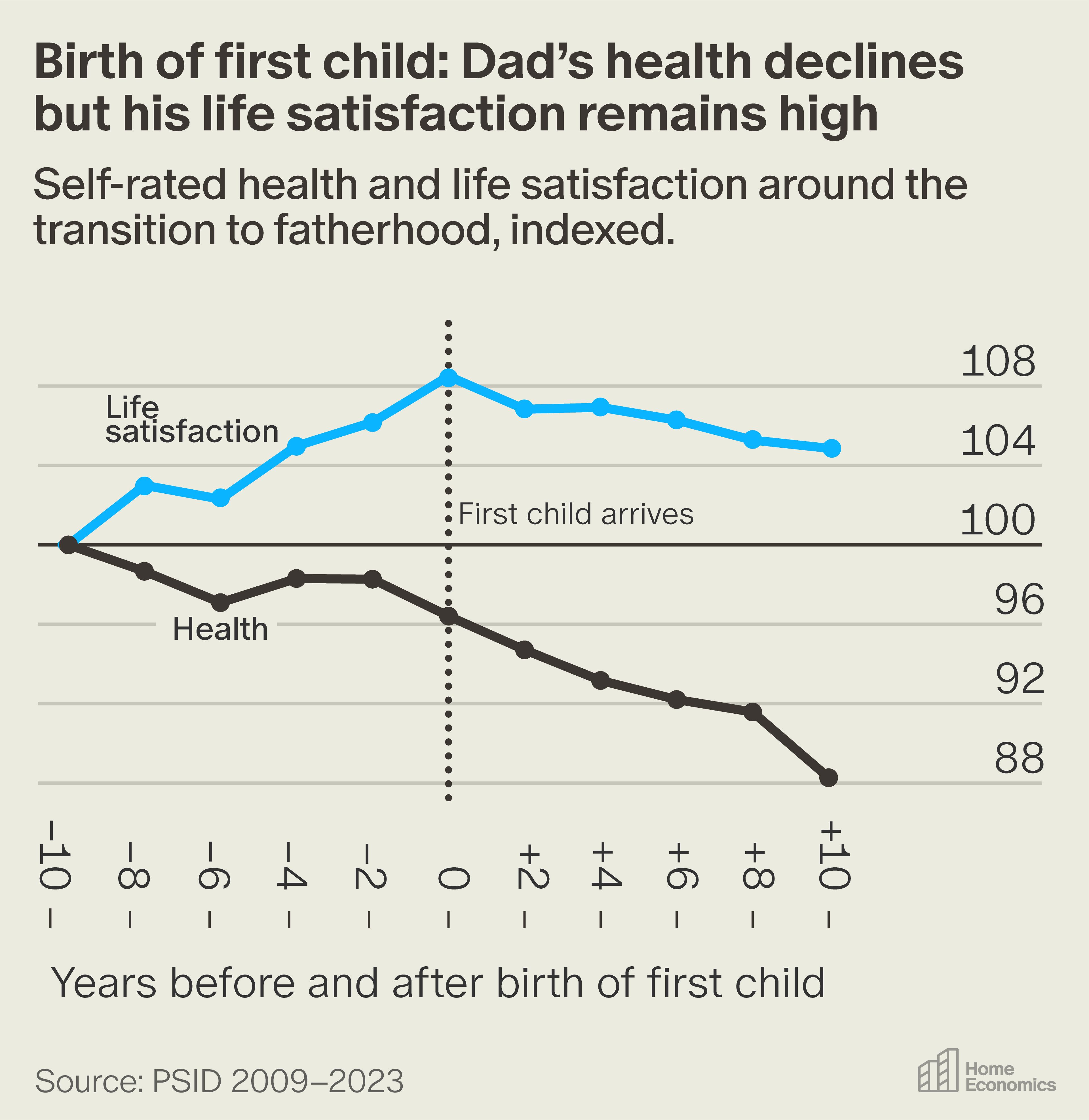
As our research shows, dads are less likely to say they’re well-rested than non-dads. They have less free time, are more overwhelmed, and are more likely to be exhausted while feeling like they didn’t finish everything they wanted to. But this burden of time pressure comes with significant joys. Dads in the same surveys are more likely to say that life is “close to ideal” and that they would “change almost nothing.”
Survey results do not always offer deep wisdom. But here at least, their findings are wise. The lost hours of sleep are easy to count. The joys are harder to quantify. But they are profound.
For the sake of methodological transparency, it is probably worth pointing out that we make do with the data we have. In this article, we are comparing the American Time Use Survey, a federal questionnaire that goes back to the early 2000s, with data from the American Heritage Time Use Survey, a similar but different survey whose records go back into the mid-1900s. Drawing trends across different surveys can be messy, but it is common for sociologists and academics to compare ATUS and AHTUS data to track long-term changes to the way that Americans spend their time.
While the Ramey-Ramey study is famous, it is also contested. As the economist Eric Hurst has pointed out, the change in childcare time spent by highly educated parents relative to less educated parents is driven by parents of young children under 5. Both of the authors of this paper have children under 5, and it’s not entirely intuitive to either of us that reading Brown Bear Brown Bear What Do You See for the 10 millionth time is the equivalent of a college-prep course.
 | A guest post by
|
Being an active father is one of the best gifts you can give yourself. Not only does it give you rich relationships when your children are young and at home but it lays the foundation for rich relationships when your children are adults. I was born in 1962 so I could easily have been more of a boomer dad on the sidelines but my wife pushed me early on to make my very young children a priority, and I'm forever grateful to her for that.
Another factor at work here is that today fathers, like everyone else, are at home more of the time (no data, just what I think I see). Work from home is part of this, but even more so for everyone in "leisure" time. The decline in community participation - church, clubs, organizations - and in non-home recreation ( bowling leagues, hanging out in bars, etc.) simply puts Dad in the home for more hours.